If you need to go to an emergency room in Korea, it helps to bring ID, medication information, allergy information, and an emergency contact. But the most important rule is simple: do not delay emergency care just to collect documents.
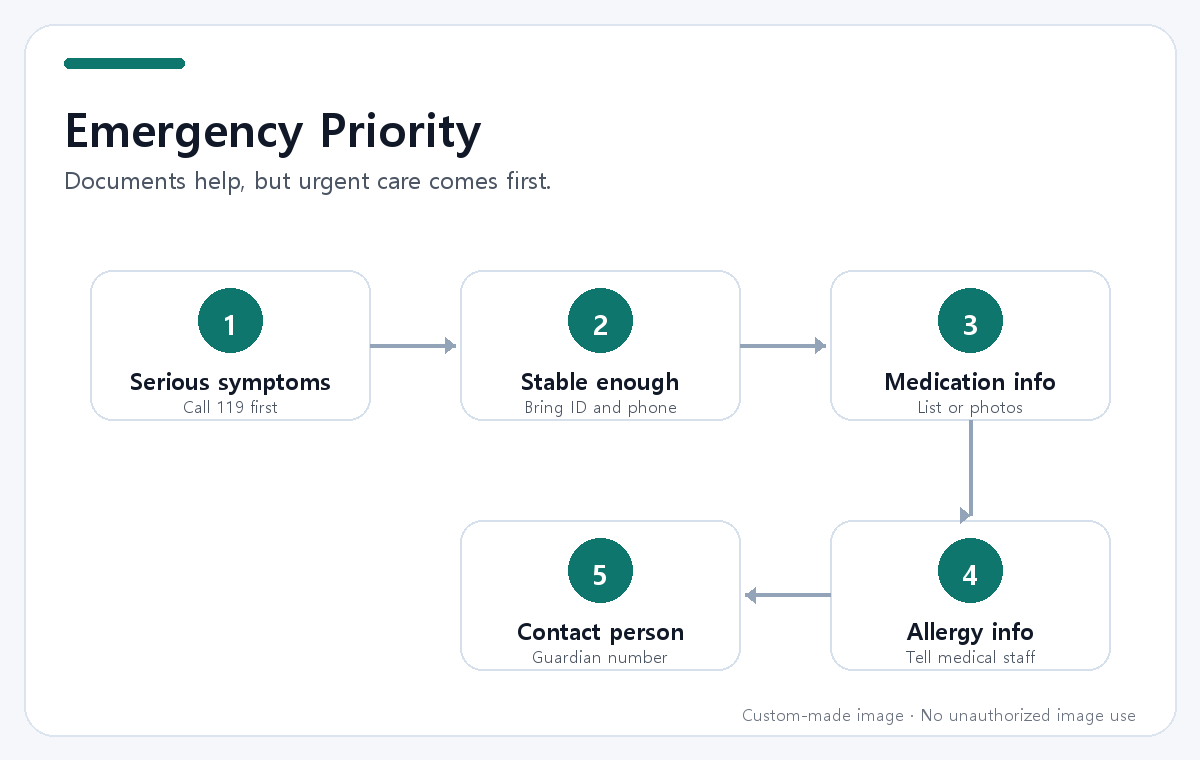
If the patient has severe chest pain, trouble breathing, loss of consciousness, stroke-like symptoms, heavy bleeding, a major accident, or a sudden severe condition, call 119 or go to an emergency medical facility as soon as possible.
✅ Who this guide is for
This guide is for foreign residents, travelers, students, workers, and families in Korea who want to know what information may be useful at a Korean emergency room.
This is not medical advice. In a real emergency, call 119 or seek immediate medical help.
📌 Key things to know first
| Situation | Priority |
|---|---|
| Life-threatening symptoms | Call 119 or seek emergency care first |
| Patient cannot speak clearly | Guardian should explain symptoms and history |
| Patient is stable enough to prepare | Bring ID, phone, medication, and allergy info |
| ID is missing | Do not go home just to get it; tell reception staff |
Emergency departments may use triage. This means patients may be seen based on severity, not only arrival order.
🔎 What to bring if possible
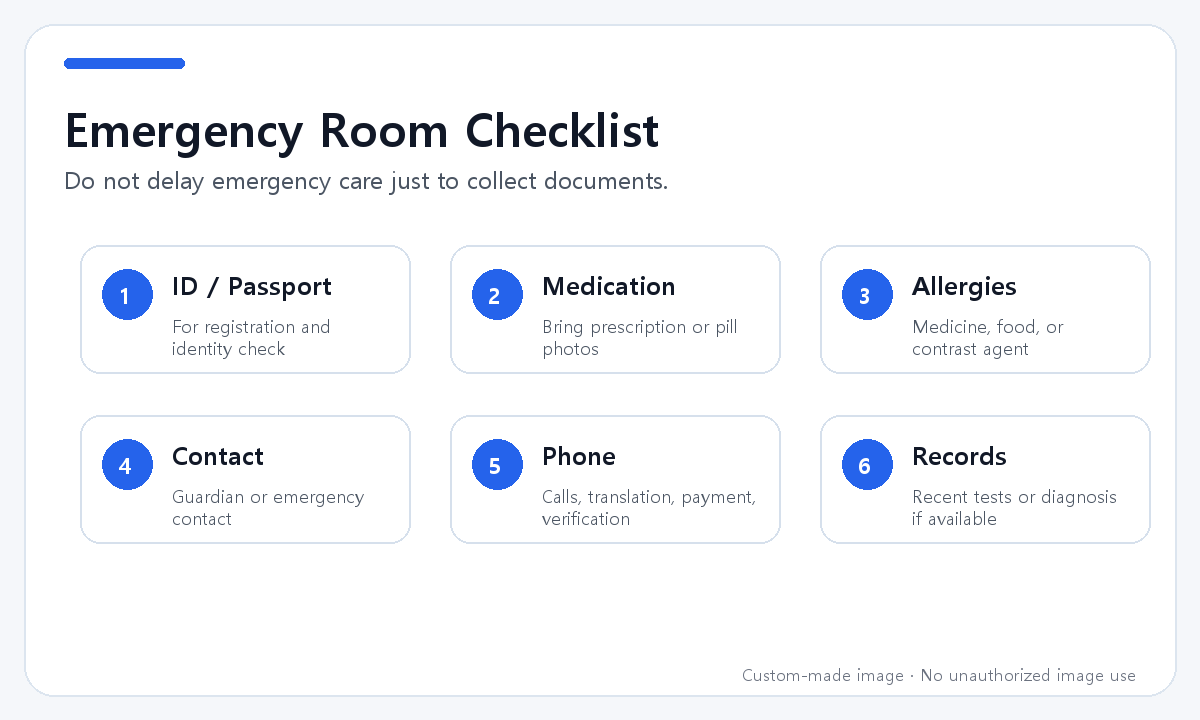
| Item | Why it helps |
|---|---|
| ID card or passport | Registration and identity check |
| Residence card | Helpful for foreign residents |
| Phone | Contacting family, translation, payment, verification |
| Medication list | Helps prevent duplicate or unsafe prescriptions |
| Allergy information | Important for medication and contrast agents |
| Recent medical records | Helps explain diagnosis or recent tests |
| Emergency contact | Needed for explanations, consent, discharge, or admission |
| Payment method | May be needed for payment or hospital procedures |
If you do not know the medication names, bring the pill package, prescription paper, or photos of the medicine.
🛠️ ID and health insurance notes
Korea strengthened identity checks at medical institutions for health insurance use from May 20, 2024. Because of this, it is safer to bring a valid ID when visiting a hospital.
Examples may include:
| Person | Possible ID |
|---|---|
| Korean citizen | Resident registration card, driver's license, passport |
| Foreign resident | Residence card, passport, other accepted ID |
| Mobile option | Official mobile health insurance card where accepted |
Actual handling may differ depending on the hospital, patient condition, and registration process. If you do not have ID during an emergency, tell the reception staff or medical team. Do not delay urgent care.
⚠️ Information a guardian should prepare
If the patient cannot explain clearly, a guardian should try to provide:
- When symptoms started
- Main symptoms
- Recent medication
- Allergies
- Existing diseases
- Recent surgery or hospitalization
- Emergency contact information
Short, clear information is usually more helpful than a long explanation.
💡 FAQ
Can I receive emergency care without ID?
Do not delay emergency care because of missing ID. Tell the hospital staff about the situation. The actual process may vary by hospital and patient condition.
Should I call 119?
If the situation looks serious, call 119. This guide is only a preparation checklist and cannot judge whether your symptoms are an emergency.
What if I do not speak Korean?
Bring your phone, a translation app, and a Korean-speaking contact if possible. In a serious emergency, focus on getting medical help quickly.
Is the mobile health insurance card enough?
It may be accepted in some situations, but phone battery, login status, and hospital process can vary. If possible, bring physical ID too.
❓ Disclaimer
This guide is for general information only. Emergency care, identity checks, billing, triage, insurance handling, and documentation requirements may vary depending on the hospital, patient condition, insurance status, and residency status. In a real emergency, call 119 or seek immediate care.
🧾 Official sources
- Emergency Medical Portal E-Gen: https://www.e-gen.or.kr/egen/main.do
- National Health Insurance Service: https://www.nhis.or.kr/nhis/index.do
- Mobile health insurance card information: https://www.nhis.or.kr/nhis/minwon/wbhaba03600m01.do
- Ministry of Health and Welfare: https://www.mohw.go.kr/
'생활꿀팁' 카테고리의 다른 글
| 건강검진 전날 물 마셔도 될까? 검사별 주의사항 (0) | 2026.07.22 |
|---|---|
| 건강검진에서 재검 나오면 다음에 해야 할 일 (1) | 2026.07.21 |
| 응급실 갈 때 신분증과 준비물 체크리스트 (1) | 2026.07.20 |
| How to Change or Cancel a Health Checkup Appointment in Korea (0) | 2026.07.19 |
| 건강검진 예약 변경과 취소 방법 (0) | 2026.07.19 |


